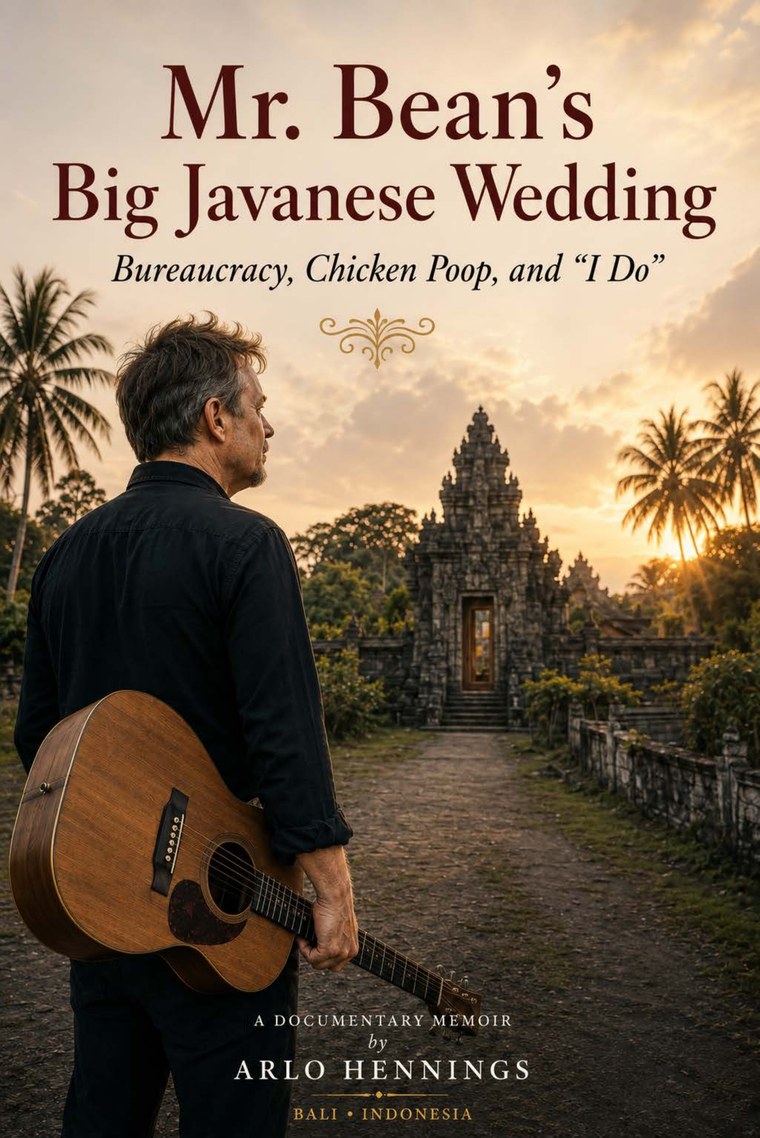
People have asked me for years why I call this Mr. Bean’s Big Javanese Wedding.
The answer is simple.
Standing with a guitar over my shoulder, I was an obvious curiosity in a small East Javanese village where few foreigners had ever visited. Every walk through the neighborhood drew smiles, waves, and laughter. Children followed me down the street. Grandmothers stared from their front porches. People greeted me as if I had stepped out of their television.
Someone decided I looked like Mr. Bean.
The nickname spread through the village almost overnight.
I never objected. Rowan Atkinson’s famous character has an extraordinary ability to stumble into impossible situations with equal parts confusion, determination, and luck.
That wasn’t a bad description of my introduction to Javanese bureaucracy.
What follows is a true story.
Every conversation, ceremony, misunderstanding, and bureaucratic obstacle happened exactly as described. Some names have been changed to protect privacy, but the events remain faithful to memory.
This is not simply a wedding story.
It is a story about family, culture, patience, humor, and discovering that when you marry someone from another world, you don’t just gain a spouse—you gain an entirely new way of seeing life.
Welcome to my Javanese wedding.
Will You Marry Me?
It wasn’t in a fancy restaurant. It wasn’t on a beach at sunset. It was on a small wooden bench in front of Tuti’s family home in Pandaan, East Java.
We had been together for more than a year. We had laughed, we had fought, and we had learned how to survive each other’s cultures, languages and families. I knew I wanted the rest of my life with her.
I had rehearsed what I would say a hundred times in my head. When the moment finally came, my heart was racing like a teenager’s.
“Tuti,” I said, “will you marry me?”
She didn’t answer right away. She just smiled, looked down for a moment, and then said softly,
“I will. But first… you must marry Indonesia.”
I had no idea what that meant.
I would learn soon enough.
The Journey to East Java
After we decided to marry, I had to go to Pandaan, East Java, to meet Tuti’s family and ask for their blessing.
It was my first trip to East Java. From Bali, I flew to Surabaya and then took a bus south toward the mountains.
The farther we got from the city, the more the landscape changed. The traffic disappeared. The air got cooler. Life slowed down.
Rice paddies stretched in every direction. Villages were small and quiet. People lived close to the land—and to each other.
I didn’t speak the language. I didn’t know anyone. I carried one guitar, a small bag, and a heart full of hope.
And a thousand questions.
Morning in Uncle Matt’s House
Before meeting Tuti, most of the Indonesian women I had encountered worked as domestic staff, shop tellers, or waitresses. Tuti was the first Javanese woman I had ever really known, and my understanding of her culture was severely limited.
She was marginally educated, deeply humble, and incredibly malu (shy). She had never heard of the Occupy Movement, women’s liberation, feminism, the #MeToo movement, Woodstock, or 9/11. Her knowledge of the United States was limited to a few pop stars and the name of the current president.
Given the language barrier alone, any betting man would have called our relationship a long shot. But I chose to view the glass as half full.
On the big day, Uncle Matt’s house was a hive of activity. The pink cement walls showed their age with long, character-building cracks, and a century-old, black-and-white family photo hung distinctly crooked above the door.
Under the pale twilight of a single low-watt ceiling bulb, a dozen Javanese women sat in a circle on the floor, efficiently prepping gift boxes of chicken, vegetables, rice, and chili sauce. Others were busy clearing the living room furniture to make space for the guests.
By the time I finished my morning coffee, Tuti had already vanished to a salon. My sole responsibility for the morning was to bathe using a bucket of cold water.
Cultural Insight
Understanding a Traditional Javanese Wedding — although every region of Java has its own customs, most traditional weddings follow a sequence of symbolic rituals celebrating family, commitment, and community. The ceremony described in this chapter reflects traditions commonly practiced in East Java.
Before the Wedding
- Lamaran
- The formal marriage proposal in which the groom’s family visits the bride’s family to ask for her hand.
- Siraman
- A ritual purification in which the bride and groom are bathed with flower-infused water by parents and elders.
- Adol Dawet
- The sale of cendol (dawet) using clay coins, symbolizing prosperity and abundant guests.
- Midodareni
- The evening before the wedding, when the bride remains in seclusion while relatives gather and the groom’s family presents gifts.
- Seserahan
- Gifts from the groom’s family symbolizing his commitment and ability to provide.
The Marriage Ceremony
- Ijab Kabul
- The official religious marriage vows that legally solemnize the union.
- Panggih
- The ceremonial meeting of the bride and groom as husband and wife.
- Balangan Gantal
- The couple throws small rolls of betel leaves at one another, symbolizing acceptance despite each other’s imperfections.
- Wijikan
- The bride washes the groom’s feet as a traditional gesture of respect and devotion.
- Kacar Kucur
- The groom pours symbolic gifts of rice, seeds, and coins into the bride’s hands, representing his responsibility to provide.
- Dahar Kembul
- The newlyweds feed one another, symbolizing harmony and shared prosperity.
Family Blessings
- Sungkeman
- The bride and groom kneel before parents and elders to ask forgiveness and receive their blessings.
- Tampa Kaya
- The groom symbolically entrusts his earnings to his wife, recognizing her role in managing the household.
- Unduh Mantu
- A celebration hosted by the groom’s family to formally welcome the bride into her new family.
Not every ritual appears in every Javanese wedding. Customs vary by region, family tradition, and religious practice.
A Walk Through the Village
Clean and dressed, I took a stroll through the village, carefully tiptoeing down a broken pathway paved with chicken droppings and navigating around the open sewage creeks that crisscrossed the neighborhood.
Unlike Bali, which is overrun with wild dogs, this Javanese kampung (village) preferred feral cats and caged pet birds. The dense grid of weather-beaten houses was brightened by vibrant flower pots in shades of red, blue, and pink. Front terraces and laundry lines opened right onto the street, creating an immediate sense of community.
I was an instant celebrity. Children chasing each other with ceremonial pecut whips paused to look at me. Power lines were tangled with lost kites, the air smelled of burning rubbish, and locals greeted me with a cheerful, drawn-out,
“Gerd m-o-o-ning, Miztrrr!”
Women held out their babies for me to see, smiling and blushing. I could only imagine what they were thinking. For all intents and purposes, it was as if Mr. Bean had stepped out of their television screens and directly into their village. I received rock-star treatment, and I loved every minute of it.
Turning a corner, I ran into a badut—a colorful traveling street clown who entertained neighborhoods with music, comedy, and playful performances.
By 3:00 PM, the loudspeakers from the local mosque reminded me that it was time to head back.
The Wedding Ceremony
A traditional Javanese Islamic wedding is a beautiful, ancient affair steeped in music, folklore, and mysticism. Hour by hour, Uncle Matt’s house packed tightly with relatives. Fortunately for them, they only had to memorize one new Western name. I, on the other hand, stood no chance with theirs. Guests arrived in their finest sarongs, peci hats, and colorful hijabs, offering a slight bow before taking their places on the floor.
Tuti had wisely vetoed the traditional, Aladdin-style groom’s attire. Instead, she asked Uncle Matt to outfit me in one of his old business suits. It was too late to buy a new one, so I squeezed into a jacket and trousers that smelled distinctly of musty footwear. Uncle Matt generously doused me in cologne, which did not improve the odor profile so much as complicate it. I rounded out the ensemble with new black shoes, a gold tie, and a traditional peci hat edged with golden leaves.
Looking in the mirror, I barely recognized myself. I wasn’t a man defined by past relationship failures anymore. I straightened my tie, adjusted my hat, and told my reflection,
“Today is the first day of the rest of your life.”
Pak Modin, the elderly holy man, arrived and seated us at a small table on the floor. He sat across from me and asked me to recite my vow. When I did, he shook his head in immediate disapproval. I had memorized the wrong version.
As he scribbled out a correction, Tuti’s semi-English-speaking cousin leaned over and whispered,
“You have a few minutes to get this right. Otherwise, you’ll be reciting it in front of everyone until you do.”
I furiously practiced the script…
Lost in Translation
On my second attempt, Pak Modin smiled in approval.
Tuti’s older brother, Kamid, stepped forward to represent her late father, and when her turn came, Tuti glowed like a widodari (goddess) as she flawlessly delivered her vows.
Sitting there without a guide or an interpreter, I had absolutely no idea what was happening.
I misplaced the wedding ring.
I handed over the dowry at the completely wrong moment, effectively reversing our traditional roles to the absolute delight of her family.
They thought I was a natural comedian.
Every few minutes someone would gently reposition me, point toward another relative, or motion for me to sit, stand, smile, or sign something. I simply followed directions and hoped for the best.
For everyone else, the ceremony unfolded according to centuries of tradition.
For me, it felt like trying to perform in a play without ever having seen the script.
When we finally paused for photographs, I caught my first good look at Tuti.
She looked absolutely stunning in her white lace kebaya.
At that moment, every bureaucratic headache, every language barrier, and every ounce of uncertainty disappeared.
Whatever happened next, I knew I had made the right decision.
The ceremony concluded with prayers before a long reception line of relatives and neighbors. I greeted each guest by taking their hands and touching them respectfully to my forehead.
Only then were we finally allowed to share Tuti’s old bedroom without bringing theological shame upon the household.
The day had been a whirlwind of confusion, laughter, customs I barely understood, and extraordinary kindness.
I thought the hard part was over.
It wasn’t.
The Paper That Wasn’t Worth the Ink
Two days after the wedding, Pak Modin called me to his office with a long face.
“Maaf, Arlo,” he said gently. “There is a problem. Your marriage is declared void.”
Void. Just like that.
Some bureaucratic requirement had been missed or a box left unchecked. No one seemed to agree on what went wrong. What was certain was that, in the eyes of the law, Tuti and I were nothing more than a dramatic costume change.
I felt like I had been hit by a chicken.
We laughed about it later, but at that moment my stomach dropped to my sandals.
To make it legal, we would have to start over—this time at the Department of Religious Affairs in Pandaan, an hour north of Malang.
Marriage in Indonesia isn’t just a celebration. It’s a multi-step bureaucratic pilgrimage with more paperwork than a small business loan.
But we were in it now. For real this time.
We gathered the documents, straightened our kebaya and batik, and headed into the belly of the system.
Our honeymoon would have to wait.
The Missing Box
The paperwork said we weren’t married. Not just a technicality. Declared void. Batal.
I stared at the words on the letter from the Department of Religious Affairs as if they might change if I blinked.
“Your marriage file is incomplete,” the letter explained. “Therefore, your marriage is void. Please resubmit the required documents.”
We had done everything right—according to custom, according to tradition, according to Pak Modin.
But according to the government, one small box on one small form had been left unchecked. And no one caught it at the time.
That tiny empty box erased our wedding.
In Indonesia, love may be blind, but bureaucracy has 20/20 vision.
Now it was our turn to enter the labyrinth.
Another trip. Another office. Another stack of forms. Another “come back tomorrow.”
We gathered every document we could find—birth certificates, ID cards, photos, letters, witness statements.
We photocopied. We stamped. We signed. We waited. We smiled.
We did it all over again.
Because this time, we weren’t just playing the part.
This time, we were getting it right.
Love had brought us together.
Paperwork would have to keep us together.
The Consulate Solution
Back in the U.S., I called the State Department.
The nice woman on the phone said, “You need to contact the U.S. Consulate in Surabaya.”
So I did.
Within a week, I received an email from the Vice Consul.
He had read my story and said, “We’ll help you get this fixed.”
He sent me a list of documents, explained the process, and even offered encouragement. The list was short but firm: birth certificate, passport copy, marriage documents, divorce decree with apostille, photos, and affidavits or statements.
For the first time in weeks, I felt like someone was on our side.
Our next trip: Surabaya.
The U.S. Consulate was modern, efficient, and air-conditioned—just like America.
We submitted our file. We answered questions. We signed more papers.
The Vice Consul reviewed everything personally.
A few days later, we received the news we had been praying for.
A few days later, we returned to the Consulate.
The Vice Consul handed me back our file with a smile.
“Your marriage is now legally recognized by the United States.”
Just like that.
All the confusion, the void letter, the missing box, the extra trips, the translations, the stamps, the money, the waiting—
It had finally paid off.
But the journey wasn’t over yet.
There was one more stop on our pilgrimage.
The big one.
Washington, D.C.
To the place where ink becomes law.
Married Again.
After weeks of paperwork and waiting, the day finally arrived.
There was no big church, no white aisle, no tuxedos.
There was a small KUA office, our families, a few friends, and a mountain of emotion.
Tuti wore her kebaya—elegant, traditional, and breathtaking.
I wore a suit and a rented songkok.
We were equal parts nervous and excited.
The penghulu spoke in Indonesian.
We answered “Ya”.
Twice.
And with that, we were husband and wife.
No confetti. No Champagne.
Just smiles, tears, and a whole lot of relief.
It wasn’t the wedding we dreamed of back in the States.
It was something better.
It was real.
It was ours.
It was the start of our life together.
The day was simple, but full of heart.
There were no tuxedos, no white aisle, no choir. Just family. Just friends. Just faith and tradition.
Our families prayed. The penghulu led. The words were spoken. The promise was made.
Rings were exchanged—not for show, but as a symbol of trust and devotion.
A signed book. A stamped certificate. Two families. One commitment. One future.
It wasn’t the wedding we once dreamed of in America. It was better. Because this one was real. Because this one was ours.
Married…Again
We thought the adventure was over.
It wasn’t.
After the wedding, the village authorities reviewed our paperwork and declared our marriage legally invalid. As far as the government was concerned, we still weren’t husband and wife.
Our marriage book disappeared into the bureaucratic labyrinth of the Department of Religious Affairs while officials sorted out a collection of forms, approvals, and technicalities that seemed to multiply with every visit.
Eventually, after enough signatures, stamps, and trips through government offices to satisfy even the most determined bureaucrat, we finally received our official marriage books.
Or at least as normal as life in Indonesia ever becomes.
Ten Years Later
A New Beginning, A Deeper Understanding
We recently celebrated our tenth anniversary.
Over the decade, our communication has vastly improved—even though Tuti still laughs when I try to speak Indonesian. I still laugh when she tries to help me.
It has been a challenging but wonderful journey. I have been embraced by a family and a culture that once felt foreign but now feels like home.
It will likely take me a lifetime to fully comprehend Javanese culture, language, and traditions. But that’s the beauty of it—there’s always more to learn, more to appreciate, and more reasons to be grateful.
I like to remind people that in my first two marriages we all spoke fluent English, thought alike, and shared a similar upbringing. This time, we come from different worlds, speak different languages, and see life through different eyes.
Yet somehow, it works.
Not because it’s easy, but because it’s real.
Ten years have passed since I married Tuti in a small village in East Java. What began as a leap of faith has become a life beyond anything I ever imagined.
Together we have built a home, raised our daughter Sabrina, and faced challenges that tested us in ways we could never have anticipated. Through it all, we have learned that love is not just a feeling—it is a choice made every day.
Indonesia continues to teach me humility, patience, and gratitude. Its people, traditions, and spirit have become part of who I am. I am no longer a visitor here—I belong.
As I look back on this journey, I see that marriage was not the end of the adventure. It was the beginning of a deeper story—one still unfolding, one I am honored to live.