Left Out of the Liner Notes
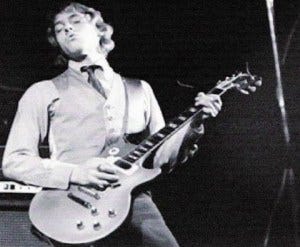
I offer kudos to Cyn Collins’s Complicated Fun: The Birth of Minneapolis Punk and Indie Rock, 1974–1984 (Minnesota Historical Society Press, April 1, 2017).
One reviewer wrote: “If you were alive in Minneapolis, you need this book.” That is accurate.
Nearly ten years after its publication, I have one small correction to make.
There is one part of the book’s history that I know firsthand and believe is inaccurate. Rock ’n’ roll history is full of conflicting memories, bloopers, and “he said, she said” stories, so this is not a condemnation of Collins or her book.
But this is Minneapolis music history, and I believe my story belongs in the record. I do not know Collins personally.
My old musician friend Wayne Hasti told me Collins was putting together a book about Jay’s Longhorn, an underground music hotbed of the late 1970s and early ’80s. I contacted Collins by email, and, to be perfectly honest, she wasn’t particularly interested in what I had to say about the Longhorn.
I had performed there, along with many others, beginning in 1979, and I knew the scene firsthand. I gathered that because Collins didn’t know who I was—and I wasn’t a celebrity during the period she was documenting—my stories weren’t considered useful.
I wasn’t too broken up about it. Many other stories were cut too. As an author myself, I understand that you can’t put everything into a book. There are only so many pages.
But this is the story I want to correct.
Collins wrote several paragraphs about the local popular band The Suburbs, including the history of what I remember as the “pre-Suburbs” Tsetse Flies. What was printed about my involvement with the Flies is inaccurate.
Here’s what actually happened.
I made Collins aware that I had been a member of the Flies. I also asked Chris Osgood—one of the featured musicians in her book, who saw me with the group—to speak with her. I asked fellow Flies members Hugo Klares and Michael Halliday to correct the story as well.
It didn’t happen.
So, What Was the Tsetse Flies?
In 1977, Steve Knaeble, my roommate and co-originator of my future band Vitamin Q, introduced me to a visionary guitarist named Bruce Allen.
Bruce was a short, self-effacing MCAD art student who was starting a punk band he dubbed the Tsetse Flies.
At the time, I was Hugo Klares’s roommate. Hugo was friends with Bruce Allen and Michael Halliday. I was asked to jam with the group as the rhythm guitarist.
The lineup at that time consisted of:
- Bruce Allen — lead guitar and vocals
- Michael Halliday — bass
- Hugo “Huck” Klares — drums
- Arlo Hennings — rhythm guitar
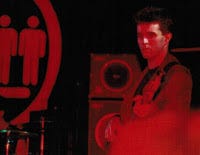
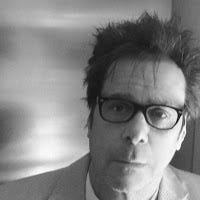
We practiced in the living room and basement of a rented house at 3545 Minnehaha Avenue for approximately six months.
Not at Podany’s.
The Podany space mentioned in Collins’s Complicated Fun happened later, according to my recollection.
Bruce’s friends Chris Osgood and Steve Almaas of the Suicide Commandos would check on our progress from time to time.
At the time, Hugo and Michael worked at Pracna On Main. I did odd jobs. I can’t remember exactly where Bruce worked, only that it was in graphic arts.
The Memory Problem
Collins quotes Hugo Klares and Michael Halliday as saying that Johnny Knaeble jammed with the Tsetse Flies and that they didn’t remember me.
That is difficult for me to reconcile with what I remember.
I was Hugo’s roommate. I was asked to join the Tsetse Flies as their rhythm guitarist. I rehearsed with Bruce, Hugo, and Michael for approximately six months at our house on Minnehaha Avenue.
So the idea that Hugo and Michael simply didn’t remember me doesn’t make much sense.
Johnny Knaeble did apparently jam with the group at some point, but his involvement came later, after my time with the Flies. I don’t dispute that he may have played with them.
For some reason, that’s the person Hugo and Michael chose to put on the record.
I also tried to locate Hugo and Michael myself, but I couldn’t find them. If Collins was in contact with them while researching the book, she never offered to put us in touch or to try to resolve the discrepancy.
She never told me it was too late to make a change. She never explained why their recollection differed from mine. The opportunity to settle the matter was there, but it wasn’t pursued.
It felt like a snub.
I’m not saying that to claim special importance or to demand a place in somebody else’s history. I simply took it as a message that my involvement wasn’t important enough to warrant resolving the discrepancy.
And that’s where the issue of being left out of the liner notes comes in.
I’ve seen musicians get worked up over being left out of the liner notes of a record. That’s understandable. Credits tell us who was there.
But these are different kinds of liner notes.
These are the memories, people, rehearsals, and songs that existed before there was a record to put them on.
When you’re the person who was there, being left out isn’t quite so minor.
When Is a Band a Band?
The Flies never performed live or recorded, but the songs we jammed on were composed by Bruce Allen.
One of those songs was “Chemistry Set,” which the Flies workshopped during our rehearsal period.
The song later became part of The Suburbs’ recorded history. It appeared as track five on The Suburbs’ self-titled nine-song, 7-inch EP, released by Twin/Tone Records on April 17, 1978. It was the debut release for both the band and the label. The song was later included on the 1980 album In Combo.
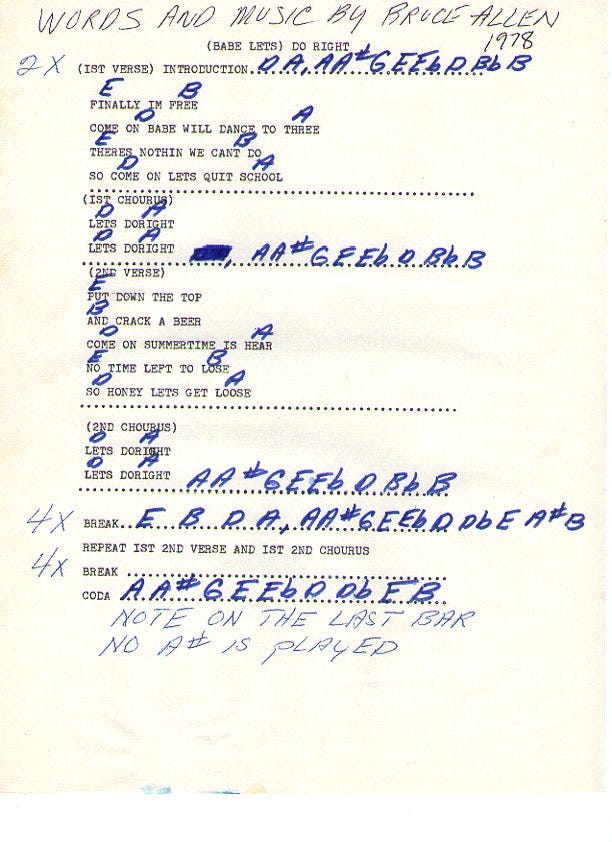
I also wrote down another one of the songs we worked on—a song called “Do Right”—and later taught it to my next band, Vitamin Q.
As the opening band for The Suburbs, I performed my version of the song at the Longhorn in 1979, to Bruce’s liking.
During my short-lived stint with the Flies, Bruce eventually asked me to leave the band.
I have the deepest respect for Bruce Allen and for what the guys went on to accomplish.
“Do Right” was written by Bruce Allen during the Tsetse Flies period.
I was there.
I remember the house. I remember the rehearsals. I remember the lineup. I remember being asked to play rhythm guitar. And I still have the handwritten chart for Bruce Allen’s “Do Right.”
The quiche pie Hugo brought home from Pracna On Main was really good too!
That’s what I’m putting on the record.