There are moments in life when you realize a story didn’t end where you thought it did.
Most people know Dean Kay as the songwriter who co-wrote “That’s Life,” the song Frank Sinatra transformed into a timeless standard. Music historians remember him as a successful publisher, executive, and one of the music industry’s most respected publishing executives. I remember him for something much simpler.
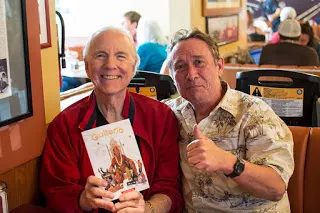
The photograph beside this story was taken many years after our first meeting. Dean is smiling, holding a copy of my memoir, Guitarlo. The contracts had long since expired. The music business had reinvented itself several times over. Yet seeing him again reminded me that some relationships outlast the deals that first brought people together.
To understand why that photograph means so much to me, we have to return to Los Angeles in 1989.
The Man Behind the Desk
By the time I walked into Dean Kay’s office, I had already learned that Hollywood could be intimidating.
Most meetings ended before they began.
Receptionists protected executives like palace guards. Assistants perfected the art of saying no politely. Unknown songwriters were expected to disappear quietly after leaving a cassette behind.
Dean’s office was different.
It was spacious enough to feel almost like a condominium, but what caught my attention wasn’t the size of the room.
It was the photograph sitting prominently on his desk.
Not a gold record.
Not an award.
Not a celebrity.
A photograph of his wife and daughter.
Before he spoke a word, I learned something about the man.
Family came first.
Looking back now, that small detail told me more about Dean Kay than any résumé ever could.
A Songwriter Listening to Songwriters
Dean didn’t become successful because he stopped thinking like a songwriter.
He became successful because he never forgot what it felt like to be one.
He began playing the cassettes I had carried with me from Minneapolis.
One song.
Then another.
Then another.
Most executives had already formed an opinion within the first thirty seconds.
Dean kept listening.
As each cassette finished, another one went into the stereo.
The telephone stopped ringing.
Eventually he asked his secretary to hold his calls.
For an unknown songwriter, that simple gesture felt enormous. Someone important wasn’t merely hearing the music.
He was listening.
“Where Are You From Again?”
“Your songs sound like finished records,” Dean said.
“Where are you from again?”
“Minneapolis.”
I couldn’t resist adding a little hometown pride.
“It’s the hometown of Prince and ten thousand other bands. The reason there are so many songwriters there is because it’s so cold you can’t go outside half the year.”
Dean laughed.
Then came another question.
“Is it cold there now?”
“No,” I answered. “It’s June.”
The conversation drifted effortlessly from music to weather and back again.
It no longer felt like an audition.
It felt like two songwriters talking.
One Question
Every turning point in life seems obvious only in hindsight.
Mine arrived disguised as an ordinary question.
“What are you looking for?”
I wasn’t chasing a record deal for myself.
I told Dean I wanted to sign the songwriters I represented to his publishing company so I could help share their music with the world.
He asked how many writers I represented.
“Six.”
Dean nodded thoughtfully.
Then, without ceremony, he picked up the telephone.
“Change my next flight to New York,” he instructed. “I’m making a stop in Minneapolis.”
He stood, shook my hand once more, and smiled.
“We’ll see what happens.”
That sentence quietly changed the course of my life.
More Than “That’s Life”
To the public, Dean Kay will always be connected with one unforgettable song.
He co-wrote “That’s Life,” recorded by Frank Sinatra in 1966, a song whose message of resilience has echoed through generations.
But reducing Dean to one song misses the larger story.
He understood writers because he was one.
He knew that every famous songwriter had once carried a demo tape into someone’s office.
He knew that careers rarely began with certainty.
They began with possibility.
Throughout his career he encouraged songwriters, artists, publishers, and executives, leaving behind something far more valuable than business transactions.
He left behind opportunities.
The Ferrari Lesson
One memory still makes me smile.
Dean had recently purchased a Ferrari.
As I climbed out, I shut the door the way I would any ordinary car.
He immediately stopped me.
“Please close the door with one finger.”
I looked at him, puzzled.
“Try it again,” he said. “Ferrari doors are as light as a feather. Everyone wants to treat my car like a truck.”
It was such a small exchange.
But somehow it captured his personality.
He wasn’t showing off the Ferrari.
He was teaching me to appreciate craftsmanship.
Years later, I barely remember the color of the car.
I remember the lesson.
Why Dean Mattered
When people look back on successful music executives, they often measure them by gold records, publishing catalogs, or famous clients.
Those achievements matter.
But they aren’t what I remember.
I remember the confidence Dean gave two unknown writers from Minneapolis.
He didn’t promise fame.
He didn’t promise fortune.
He simply listened with an open mind and gave opportunity a chance.
Sometimes that’s all another person needs.
Looking back now, I realize Dean possessed something surprisingly rare in the entertainment business.
He was generous with encouragement.
That quality cannot be measured on a balance sheet.
Full Circle
The years moved on.
Contracts ended.
Companies merged.
The music business transformed itself again and again.
Like everyone else, Dean’s career continued to evolve.
Life carried both of us in different directions.
Then one day we met again.
This time there were no demo tapes to play.
No negotiations.
No lawyers.
No publishing agreements waiting to be signed.
Only two people remembering where the journey had begun.
Dean smiled as he held a copy of Guitarlo for the camera.
Looking at that photograph today, I don’t think first about PolyGram.
I don’t think about contracts.
I don’t even think about Ferraris.
I think about the man who took the time to listen when nobody else did.
Music history will remember Dean Kay for writing “That’s Life.”
I remember him for something even more meaningful.
He changed the trajectory of my life simply by believing that two unknown songwriters from Minneapolis deserved to be heard.
For that, I will always be grateful.