One day I met an old, brown-skinned man.
His head had charcoal-colored eyebrows, silver-colored hair, and a white, scruffy beard. A half-smoked cigar smoldered in one hand and he held a shot of tequila in the other.
A red, blue, and green shawl wrapped over his shoulders.
“Hola, señor, my name is Jesus,” he welcomed me into his little office. Jesus kicked his feet up on a desk, and offered, “Care for a drink, amigo?”
“Thanks, but I'm looking for a place to stay. I read you were renting out a bus?” I said.
“Sí, señor, I have a bus that no longer runs. But once it ran for many years across the border when I carried workers back and forth. I named it Up North because that's where it went.
When I wasn't driving the bus, I ran a junkyard. My father owned a junkyard, and before him, his father too.
As far as I can remember there was always a junkyard in my family's history. What is another gringo's trash is another man's treasure.” He gulped a shot and refilled the glass.
“I followed my gringo wife to America. She is gone, but now I have another junkyard.” The end of his cigar glowed. The shot glass emptied again. He let out a long sigh.
“Can I see the bus?” He looked out the office window.
“Sí, follow me,” he replied. The old chair squeaked as he got up.
I followed him through his junkyard of dead cars and parts.
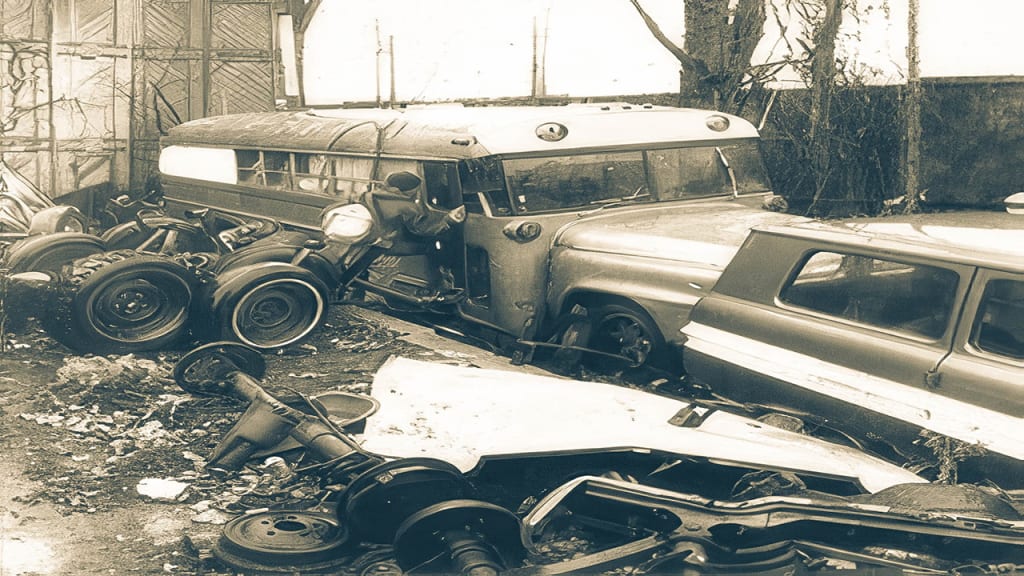
“This is it,” he said, pointing to an early-1960s Harvester school bus.
Up North rested on rusted rims.
Without its tires, the angle of the bus was so precarious that I had to sit on the side facing the doors or I’d slide off the driver's seat.
Once filled with the sound of Mexican workers, it was now a motionless heap of yellow, groaning metal. All that remained were empty booze bottles, fast-food bags, torn clothes, a broken nylon-string guitar, and a ratty sleeping bag. Most seats were torn out and converted into a living space.
“I'll take it,” I smiled. His cat jumped on his lap and meowed. “How much do you want?”
“It does get cold at night, señor,” he pulled his shawl tight around his neck.
It was the night before Christmas Eve, and I tried to imagine the darker part of a Minneapolis winter. As long as I had propane in the camping stove, it heated the bus and food.
I thought of ways to fix up the bus, like insulating the window cracks with electrical tape.
“I charge $30 per month,” he said, scratching his chin stubble.
“I will return tomorrow with the money,” I told him. “Is it okay if I stay here tonight?”
“Sí, I don't mind. I lock the gate at night. I will leave you a key,” Jesus agreed. “The cats,” he added, pointing beneath the bus seat, “Keep them rats away.”
Jesus left me to settle in.
The only light came from a hurricane-style oil lamp. A moth was hungry to land on the beam of light. It was trapped inside, now pecking at the glass, refusing to die, and looking for a way out.
Below the back windows, where it read “emergency exit,” I saw a flashing snowplow light illuminate my footprints in the early evening snow.
I tried to curl up next to the cooking stove for warmth. My soul wandered the bus frame.
Before I played my nylon string guitar, I blew into my hands for more warmth.
I turned off the pretend bus motor and crawled back into my sleeping bag. Tomorrow would be an early start if I wanted to get a low number at the Emergency Services office.
By daybreak, I made my way to the state office building. It was downtown near the courthouse. Inside a gothic-styled building above an iron gate, a sign read: County Department of Welfare.
Above a pigeon-infested exterior, the great cosmic on/off switch was on and ticking: 7:30 a.m.
“Damn it, I hope I'm not too late,” I said to a person at the end of the line.
The courthouse clock gave up seven bongs. It was the sound of an unchangeable past made on the ever-moving present.
The door at the front of the line opened. It was a steel door with no glass, a brick-framed job with bars in front.
The line was one block long and made up of society's downtrodden.
I noticed young and old, half-dead and sick, some with kids, camped out along the sidewalk like a ball of used paint rags.
On one side of the line were spiritual recruiters handing out time-share condo deals for the afterlife. Lured by food and the promise of a better life, some of the destitute reached out with a shaking hand.
Over 100 souls pushed and shoved their way into a filthy, matchbox-sized room. Under headache-inducing fluorescent lights, the suffocating, graffiti-covered space had 20 metal folding chairs.
The chairs were taken, so I stood for a while. Next, I sat on the floor and waited my turn. There was one bathroom and no water. The social workers called it the “processing area.”
One social worker explained, “It's a deterrent so you'll want to go right out and get a job!”
Everyone was assigned a case number on a first-come, first-served basis. I received the number 89. Damn, with a number that high I could wait all day. I should have camped in line overnight.
A radioactive cloud of cigarette smoke boiled above my head.
My papers arrived several hours later. If you filled them out wrong, you went back to the end of the line and did it again. I didn't know my Social Security number, and I had no address, so I invented them.
Line one on the questionnaire asked: Is there any reason to prevent you from working today?
At least, that's the way it was until Mr. Vape entered the picture. Mr. Vape (he pronounced it vaw-pee) was my caseworker.
“Number 89,” announced a voice over the intercom.
“That's me,” I called out, waving my number as if I had won the lottery.
“Mr. Vape is straight ahead, past the green partition.” An armed guard at the entrance told me, pointing to a maze of cubicles decorated with holiday ornaments. “Straight past the red and green partitions, turn left at the Santa.”
The long hallway led to bright red, green, and gold partitions zigzagging in a crazy maze.
With large files on their desks and blank, absent-minded expressions on their pasty indoor complexions, the caseworkers looked like dead Elves.
No one looked twice at the young man in orange Day-Glo sneakers, bellbottom pants, buckskin jacket, and shoulder-length hair.
I found a cubicle with the nameplate “Mr. Vape, Department of Welfare,” and sat down.
Vape raised his voice like a train was running through a tunnel.
“Hey, everyone… look. The rock star is back!” he said with a chuckle.
The room was filled with fake coughing. Without looking up from his desk, Vape licked his waving index finger.
Holding my case file with both hands, he gave me a sneer and let it drop onto his desk with a thud.
Vape's long nose turned upward. “Looking for another free ride, I presume?” Vape scowled, meaning to intimidate. “I have news for you.” He trumpeted. “You're to report for work next Monday morning—7 a.m., Room C at the courthouse… basement level.”
I took off my tennis shoes and rubbed my cold toes. “How can I do that?” I questioned. “I am not old enough to work. I turn 16 in a couple of months.”
Infuriated, Vape pulled at his blonde poodle-like toupee. Wondering what to do, he angrily lifted the black receiver of his phone.
“Hello… is this Becky's Cafeteria?” He spoke into the receiver, staring at me in disgust. “Yes, I'd like to speak with Becky. Becky…Yes. This is Mr. Vape at HCW. Yes, I'm sorry, I know you're busy. I have a new dishwasher for you. Yes, I know you're a high-class restaurant. Um, no, he hasn't had dishwasher training. What difference does that make? Hello, Becky. Are you there?”
Vape set the receiver down in silence. From his shiny, white forehead down to his pointy chin—his face was swollen.
“The opening was filled,” he grumbled, and, like a deck of cards, he gathered up my files and shuffled them off his desk.
“You know, Vape,” I cleared my throat. “I wouldn't mind going to school.”
Vape swiveled in his chair; an eye popped out. “And what type of school, pray to tell, do you suggest?” He spewed, “I read your file. It said music school. That's completely out of the question. We build future taxpayers, not vanity trips.”
Vape held his head, laughing more, and teased. “Can you carry a gun?” Then he hurled Army enlistment papers at my chest, adding. “Don't shoot your foot off.”
“But I'm not old enough to enlist either,” I argued.
Vape went through his case file again. “Where are your parents anyway?” he asked, more disgusted. “Are they dead?”
I answered with the first idea that popped into my head. “My family moved away.”
“Why didn't you go with them?” he probed.
“Well, it didn’t work out…” I explained.
“What are your plans then? You can't keep coming here the rest of your life for rent credit, food stamps, and bus tokens,” he said, closing my file.
I knew deep inside he was right. Begging for a handful of dimes was a dead end.
I could have used a break, a role model, even my parents—anything except the hard knocks. Feeling vulnerable, I acted defensively and shouted. “Someday, I will be a success. You'll see!”
“Listen to the rock star. Someday you're going to wake up and find out life's a bitch and then you die. No one cares about you or your stupid guitar,” he laughed again.
The nearby workers erupted in another belly laugh.
“Take your monthly emergency services packet and hit the bricks. I don't want to see you back here again,” he growled, handing me the papers.
“Life's a bitch and then you die. That's it?” I repeated, stunned.
“I've heard enough out of you. Beat it, rock star,” he raised his voice again, motioning toward the door.
On my way out the door, I noticed a young woman with a child. She was panhandling in the snow. I approached her, and she held the child with one arm and extended her brown hand with the other.
In a Spanish accent, she said, “Por favor, señor. My baby is hungry. Can you spare any help?”
I gave her half my food stamp ration. “It's all I have. I'm sorry.”
“Muchas gracias, señor. Feliz Navidad,” she said, blessing me.
“Merry Christmas to you too,” I hugged the family with all my might. “Do you have a place to stay?”
“No,” she shook her head.
We stared at each other, our eyelashes heavy with snowflakes.
The daylight disappeared under a freckled-white downpour of frozen rain until our silhouettes blurred into gray slush.
“Follow me. I have a bus.” I placed her backpack over my shoulders.
It would be a Christmas like none other.