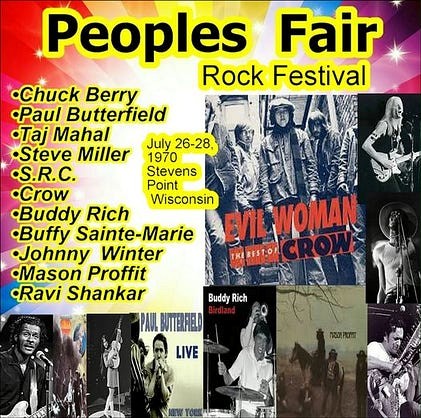
I finished the early summer of 1970 working as a stagehand for one of the outdoor rock festivals called The People’s Fair Rock Festival. It was located outside of Stevens Point, Wisconsin, on a 200-acre wooded area, highlighted by a dilapidated ski jump that overlooked the grounds like a giant wooden spine, an area that soon would be filled with bubbles, Frisbees, LSD-coated cotton candy, and street signs made from sticks named after whatever particular drug was being hawked on it.
I arrived days early to build my teepee with other crew.
The poster above reads July, but it happened in June 26–28. At the People’s Fest, I spent my time fulfilling the personal requirements of the musicians’ contract riders, and the other guys were carpenters and sound engineers.
I don’t recall hearing all the bands that were there those three days. I do remember Ravi Shankar, Buffy St. Marie, Siegel-Schwall, Iggy Pop and the Stooges, Ted Nugent w/Amboy Dukes, Chuck Berry, and White Lightning. Classic to the period, whoever happened to be on the road that month would appear at these shows.
I served hot tea to sitar master Ravi Shankar. He noticed my three-day-unwashed body and dilated pupils; he smiled at me and kindly shook his head no.
I also tended to Buffy Sainte-Marie—the faux Native American singer/songwriter who penned the anti-war anthem “Universal Soldier.” At one point I guided her up the steep stage stairs and nearly dropped her and her guitar.
I was learning more and more guitar tips everywhere I went. Like a small-scale Woodstock, the backstage scene at The People’s Fair was also ideal for meeting musicians. I got my first blues guitar instruction from blues legend Jim Schwall.
Jim was the lead guitarist for the Siegel–Schwall Band out of Chicago. His brother Corky was an amazing harmonica player and singer. The band wasn’t famous, but they were one of the best.
“This is the standard 12-bar blues progression…” Jim instructed me. “Strum four times on this chord and switch to this chord. Then do this turnaround lick like this and repeat.” He showed me how to use a bottleneck, which is a hollowed-out piece of smooth glass that fit over my ring finger. The idea was to slide it up and down the strings.
Early Sunday morning, the last day, unheard over the music, gunshots rang out toward the back of the campgrounds where a fight broke out between a motorcycle gang and the hippies. While I was backstage, I heard that several women had been raped, and many others were taken to the hospital. At least half of the estimated 48,000 attendees left after a group of fest-goers burned two gang motorbikes.
The police were moving in to shut down The People’s Fest. The promoter left without paying many on the crew, and I stood there wondering if this was “the end” the Doors sang about—no better symbolized by the angst-driven, mayhem-based group from Detroit, Iggy Pop and the Stooges.
As Iggy slashed himself with glass and was carried like an Egyptian pharaoh above the heads of his stoned disciples, destruction would become the new mother of the multi-day rock festival.