The song Nature’s Way by the band Spirit had been released only two years earlier, but its warning already hung in the air like BBQ smoke.
“It’s nature’s way of telling you something’s wrong.”
The song was a lament for the Earth, a message from nature itself. Long before climate change became part of everyday conversation, some people were already listening.
In the summer of 1972, thousands would gather in the Rocky Mountains of Colorado believing that humanity had lost its connection to the land — and that somehow it could be restored.
Garrick Beck and Barry “Plunker” Adams established the Rainbow Family of Living Light in 1970 and mailed out the initial invitations that launched the first official gathering at Strawberry Lake, Colorado, on July 19.
I was seventeen years old and eager to escape the American Dream status-quo my parents wanted for me.
I didn’t want to stick around to see what my Vietnam draft number would do. The future being offered to me felt too small. Beyond it lay roads I had never traveled, mountains I had never climbed, and adventures I couldn’t yet imagine.
When I heard about a gathering in Colorado, there happened to be one empty seat on an old school bus filled with hippies heading west.
I climbed aboard carrying little more than a hunting knife and the conviction that life was waiting somewhere beyond the horizon.
The journey ended near Strawberry Lake in Granby, Colorado, where thousands of people had converged for what would become the first Rainbow Gathering of the Tribes.
I was the youngest among a troupe of eleven travelers. Around me were wanderers, musicians, mystics, runaways, dreamers, and seekers. Some were searching for spiritual enlightenment. Others simply wanted to live differently, even if only for a few days.
The gathering was intended to be a demonstration of peace.
People of every race and background would come together to create a temporary society based on cooperation, sharing, and harmony with the Earth.
At least that was the dream.
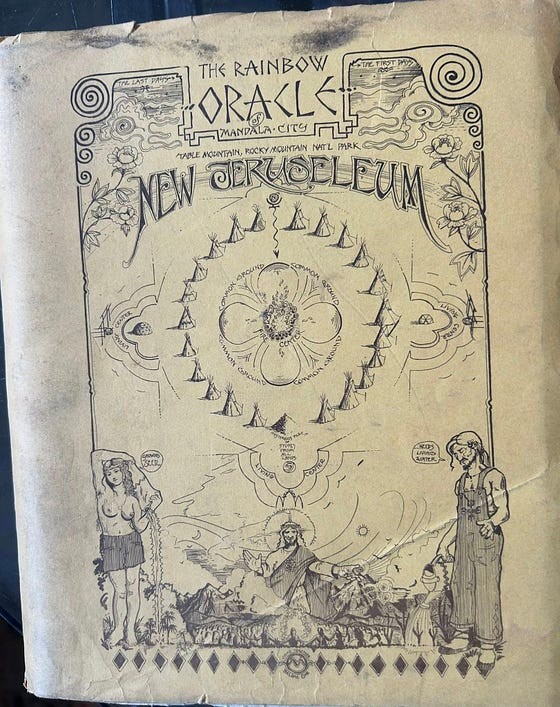
Years later, while sorting through old belongings, I rediscovered one of the original yellow pamphlets from the gathering.
The paper had become brittle with age.
Inside was a hand-drawn scripture:
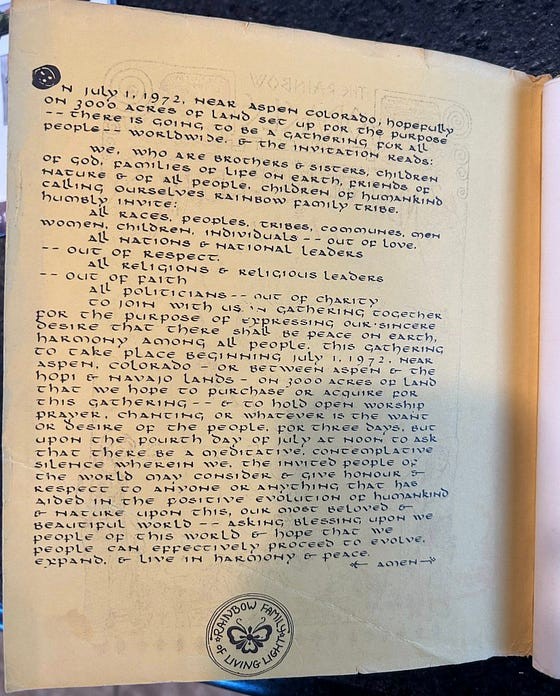
Another page in the pamphlet contained a rough route map leading into Rocky Mountain National Park and toward the gathering area.
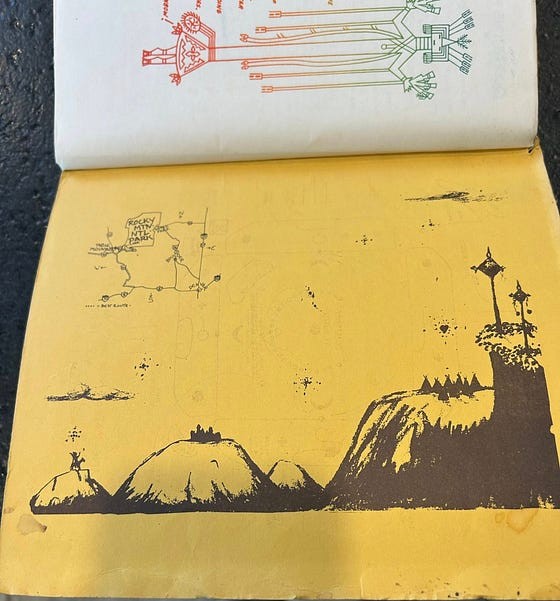
It looked as though someone had sketched it by hand at a kitchen table.
Yet somehow, ten thousand people followed those directions.
Authorities attempted to block access to the site. Police roadblocks appeared on the roads leading into the mountains. People threatened civil disobedience and continued forward anyway. Some hiked for miles carrying backpacks and sleeping bags. Others established camps lower on the mountain.
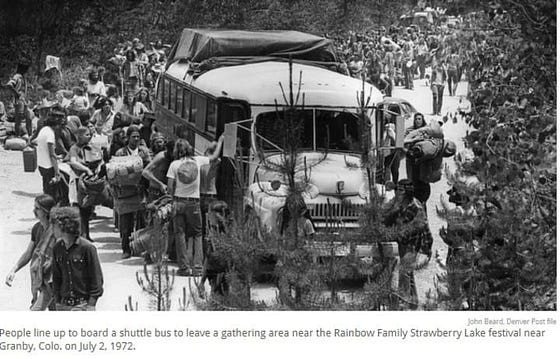
The spirit of the gathering seemed to thrive on improvisation.
Life at the Gathering
Nothing felt organized.
Nothing felt permanent.
Yet everyone kept arriving.
I joined those making the climb into the mountains.
The hike took most of a day.
Though it was July, the nights were cold at elevation. I built a lean-to from fallen branches and covered the rocky ground with leaves. That first night I lay awake shivering beneath a sky crowded with stars.
Enlightenment, I discovered, was not always comfortable.
Food was shared freely.
People brought what they had and distributed it among strangers.
Sanitation was another matter entirely.
There were open latrines and contaminated water sources, and many people became sick.
Yet despite the hardship, there was an unmistakable sense that we were participating in something larger than ourselves.
Some say there were Native American tribes who attended the gathering as well, but I didn’t see any.
I remember one white man dressed up as a Native American warrior passing what appeared to be a ceremonial wand over my head. There was talk of prophecy and of the Spirit returning to the land. Some believed the gathering fulfilled aspects of the Native American Ghost Dance vision — a renewal of harmony between people and the Earth.
Whether prophecy or wishful thinking, I couldn’t say.
I only knew that something unusual was happening.
There were no electric lights.
No stages.
No commercial sponsors.
No bands.
Yet music was everywhere.
People gathered daily to meditate. At night, campfires dotted the mountainside like lanterns floating among dark green forests.
Someone would bring a guitar.
Someone else would produce a drum.
Others played with bottles, pans, sticks, or whatever objects happened to be available.
Sometimes hundreds of voices joined together.
Sometimes a thousand.
The music drifted through the trees long after midnight.
And everywhere I seemed to go, someone was playing Spirit’s Nature’s Way.
It seemed that the song became an unofficial anthem of the gathering.
Its message fit perfectly with what many people believed they had come there to do: listen to the Earth.
I can still picture those circles of people around the fires.
Acoustic guitars.
Voices rising into the mountain air.
Discussions about peace, healing, ecology, and consciousness.
At seventeen, I wasn’t sure what any of it meant.
But I knew it mattered.
One image from the pamphlet stayed with me.
Printed in dark ink against yellow paper was a strange landscape of hills and towers called New Jerusalem.
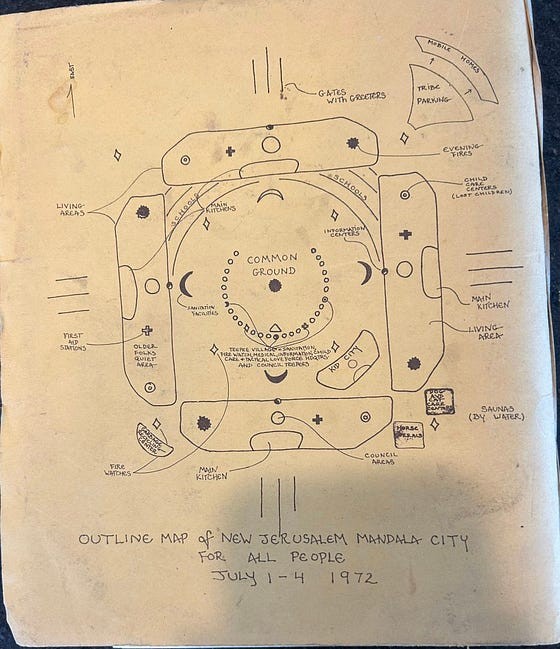
Radiating outward were plans for schools, kitchens, council areas, child-care centers, quiet places for elders, sanitation facilities, fire watches, and living areas. However, all I found was a rough campground among the trees.
Looking at it now, I realize it wasn’t really a map.
It was a blueprint for a dream.
Someone probably high on pot imagined an entire society organized around a shared center rather than competition. The drawing was simple, almost naïve, but its ambition was enormous.
At seventeen, I didn’t fully understand it.
Today I see it as a piece of counterculture archaeology — a snapshot of a generation trying to reinvent civilization with little more than goodwill and imagination.
To many gathered there, it represented the possibility that society itself could be transformed.
Not someday.
Now.
Looking back, I understand that every generation creates its own version of New Jerusalem.
A vision of a better future just beyond reach.
For four days, ten thousand people attempted to live inside that vision.
Then reality returned.
By the end of the gathering, we were hungry, exhausted, filthy, and in some cases sick.
Still, nobody wanted to leave.
We climbed back aboard the bus and headed home.
The temporary city vanished almost as quickly as it had appeared.
The people scattered.
Years later, I happened to run into the owner of the bus at a McDonald’s in Minneapolis. He was divorced, unemployed, and carrying the weight of time on his shoulders.
We talked briefly.
Then he disappeared back into history.
I never saw the others again.
That’s the strange thing about moments that later become history.
What Remains
When you’re living them, they rarely feel historic.
They feel temporary.
Improvised.
Fragile.
The Rainbow Gathering was originally intended to be a one-time event.
Instead, it survived.
Gatherings continued year after year across America. The movement outlived many of its founders and outlasted most of its prophecies.
The dream evolved.
The conflicts evolved.
Even the relationship between Rainbow participants and Native American communities changed over time.
History rarely remains faithful to its original vision.
Not long ago, I opened a drawer filled with forgotten objects from another life.
There, beneath old papers and photographs, lay a small stone.
The moment I picked it up, the mountains returned.
The campfires.
The singing.
The cold nights.
The smell of pine.
The impossible optimism of youth.
Someone had given me that stone during the gathering. I vaguely remembered being told to carry it “for the pyramid.”
Time had erased the explanation.
But not the feeling.
The yellow pamphlet still survives.
The maps survive.
The drawings survive.
The stone survives.
The city called New Jerusalem lasted only four days.
Yet somehow part of it remains.
Perhaps that was always the point.
Not to build a perfect society.
Not to change the world overnight.
But to carry forward a vision of what might be possible.
I turn the stone in my hand and listen.
The paper has faded.
Most of the people are gone.
But memory still speaks.
And somewhere beyond the campfires, beyond the mountains, beyond the dreams of a seventeen-year-old boy looking for another way to live, I can still hear the whisper:
It’s never too late for the Ghost Dance.