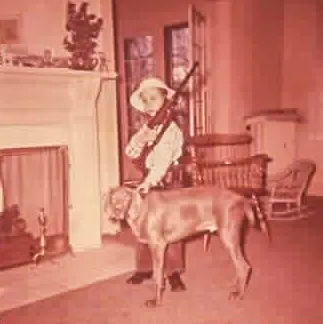
By the time I was 10 years old, I grew adventurous.
One afternoon I got 50 cents from my brother to go see a movie. I walked by myself for several blocks to the local cinema. It was the bravest thing I had ever done. My brother said the movie was scary and dared me to go. I looked up and read the marquee — Alfred Hitchcock’s The Birds. I couldn’t imagine what would be so scary about some birds. I paid my two quarters to the woman inside the glass booth, and she slipped me back a ticket through a hole in the glass.
The cinema was empty, which made the gigantic screen seem even larger. Halfway through the black-and-white movie, I was so petrified — I began to believe that what I was watching was real. I was too scared to get up and leave. The idea that nature could have its own consciousness and a revengeful one at that rattled my imagination.
On the way home, I carefully eyed the telephone wires, rooftops, and trees for any sign that a flock of birds might be gathering. My expression must have given me away.
“You look like you’ve seen a ghost,” Mom surmised. “You went and saw that scary movie, didn’t you?” she prodded.
I shook my head no while immediately becoming suspicious of our pet parakeet. The bird was named “Max,” and I thought he couldn’t be trusted.
Before my father was left mentally and physically impaired by an unsolved assault incident, a bug bit me one Christmas when I opened a box and found a telescope inside. It was bigger than a common pirate spyglass, sporting a two-inch-diameter lens, complete with tripod. The magnification couldn’t resolve the surface of Mars, but it could take me to the moon. I’d climb out of my window and up onto the roof to scan the heavens for life.
Many a night, I lay there on my rooftop zooming in on the moon, looking for any secrets that only I could be entrusted to know. The moon’s face opened up to me and revealed all of her wounds. I noted the size of every crater and the length of their shadows across the lunar soil, aka “moon dust.”
After the wonderment of the night sky turned me into an insomniac, my interest turned from outer space to inner space. For my 11th birthday, I received a 48-piece microscope set. I could now, for the first time, peer into the laboratory of life at super-magnified levels of blood, dead skin, and the body of an ant.
The set came complete with glass slides, a Petri dish, sample vials, and tweezers. Wearing my mother’s white church gloves and a lab coat fashioned from a bedsheet, I turned my microscope loose upon nature.
“Is anybody in there?” I queried while examining a piece of human hair.
My first travel machine was handmade from one of the many moving boxes left behind by my mom, who followed dad on his endless pursuit of a job. Using a flashlight, I crawled into a packing box and began to design the controls of my ship.
First, I drew a screen with a black crayon. Below the screen, I inserted sewing spindles for control knobs. With a butter knife jabbed through the box, I made a good sturdy throttle. Since my machine could travel much faster than the speed of light — just raising the knife slightly upwards shot me across the Milky Way in a blink of an eye, and in a slightly lowered position I slowed down enough to observe life on other worlds.
The last component missing was a steering wheel. I extracted the part from a broken riding lawnmower I found in my parents’ garage and mounted it into the cardboard wall below the screen. My control panel was similar to the design of the dashboard in my dad’s 1966 Thunderbird.
A simple blast of a Cracker Jack whistle announced my departure. Inside the box, I traveled to the gates of Asgard and to the center of the subatomic universe. Time was irrelevant as my machine could also travel back through time to the lower Jurassic or forward to the homeland of ancient aliens.
When the fighting between my parents got to be too much, all I had to do was enter the coordinates for another dimension, and I was carried away until I could no longer hear the violence.
When I outgrew the inside of a Mayflower mover’s box, I became fascinated with railroad tracks.
There were tracks not far from the house, and I would walk the rails, balance myself on one rail, or place a penny on a rail to watch a train smash it to twice its size. I studied the graffiti on the passing train cars. Names in strange languages in colorful red, white, and blue designs like Zapata Lives! were spray-painted over the doors. Who were the people who wrote their names on the train, and where did they come from? The rails seemed to go on forever, and there was great delight in the feeling of looking down the tracks and imagining them to be the throat of eternity.
The tracks beckoned me to take long bike trips.
Each day, I pedaled further down the road on my sky blue Schwinn Country Roamer. My wonderful bicycle, complete with its muscle handlebars and fabulous silver-ribbed stingray fastback seat, carried me into the next neighborhood, past the woods, and beyond.
My walks in the woods became longer, too — more like scouting missions to find a lost civilization. Even in the winter, I trekked out into the woods, taking note of wind direction, sunlight, cloud movement, and peculiar prints in the snow — until my feet froze and I was in dire need of shelter.
Fort building started one winter when I made an igloo out of the snow. I sat within my shiny icy dome, illuminated by my camping lamp, dreaming of polar bears snorting, whales surfacing, and the call of a snowy owl. Next, I built a year-round retreat in the rafters of our garage. From that vantage point, I could spy on my dad. I remember seeing him leave and return at all odd times of the night.
My next engineering feat took me up into the trees. High above the ground, my lofty tree shack provided a magnificent view of the Minnesota River valley and an artificial lake called Black Dog, where I speared for carp. I was also high up enough to see further across the valley and out to the edges of the city.
One afternoon, I noticed that the city was on fire as a great cloud of smoke engulfed the buildings below. Later, over dinner, my dad talked about something called nigger, and how people were rioting, destroying buildings, and should be shot.
Finally, seeking to be invisible, I went underground during the spring season, after digging an elaborate self-sustaining Earth pod and furnishing it with a sleeping bag and supplies, including Snickers bars and soda pop. The explorations became more elaborate and complex, as I added a canteen, Boy Scout compass, and a bow; with which I fearlessly shot arrows at the sun.
By 1967, when I was 13, Mom started to pack the house for the big move, and I swapped enough bottle-refund pennies, Kool-Aid stand nickels, and lawn-mowing dollars for the one-way Greyhound bus ticket from Minneapolis to St. Louis.
I didn’t put much thought into the planning of this runaway. A friend of mine had moved there and offered to house and feed me. He thought for sure his parents would learn to like and adopt me. There was no way to confirm any of his promises, nor how long it would last. It was sort of like against the rules of the adventure to ask very many questions.
As I rode the bus en route to St. Louis, I watched as my old stomping grounds disappeared behind me, along with my translucent, wide-eyed expression reflecting through a great big wide window, from high above it all in my fat cushy comfy tilt-back chair.
Riding these massive planes of sensational visual existence, I was experiencing an unfolding and refolding right before my eyes, through my translucent image in the window to a greater escape within my ever-changing reality.
Meanwhile, my riding companions and I embarked upon many spans of farmlands, rivers, and bridges like patchwork tapestry quilts alive and weaving their own stories, appearing and vanishing right before my eyes. I dreamt… “ever-evolving doors.”
Travelers treating me like a grown-up, talking in their strange accents, asked, “Where you headed, son?” Enthusiastically, I answered them with a hearty “St. Louis!” noting the southern drawl I imagined Huck Finn used while shouting for Jim after their raft was smashed apart in the fog. My fellow travelers and I were all bonded together on an adventure to paradise. In a bus or on a river raft — no matter — it was my movement toward freedom, and my freedom was where I saw fit.
When I arrived with my Huck Finn bag of clothes, the story was spun quickly by Tom.
“He’s a friend from school, and we’re doing a sleepover,” my friend Tom explained to his frowning parents.
Two nights later, Tom asked me to pull my pants down. I saw he had already done so, and I followed.
We lay there outside in the backyard, side by side, butt naked beneath the moon.
“Let’s rub ourselves,” he suggested.
The next thing I knew, Tom was down there bobber-hopping on my fishing tackle. He asked me to return the pleasure, and with hesitation, I complied. Having never done anything like that before, I didn’t know what to expect.
“Tom, don’t take this the wrong way. I like you and everything. I mean, consider me your wingman for life… but I feel very confused by what we’re doing,” I explained, “and why are we touching each other like this?”
Tom hugged me while encouraging, “It’s no big deal, really. Forget it. We’re friends, forever, and when I run for president, vote for me, okay?”
“Yeah, sure, let’s keep this our little secret,” I whispered.
Tom’s parents caught on when the sleepover lasted a week, and they asked where I lived. The adventure ended the next day after that — when the police car pulled into the driveway, and I found myself being shuffled into the back seat.
On my long ride back to Minneapolis, I felt a new sense of growth, as well as dread.
I was fingerprinted, photographed, and pushed before a judge. In an amazing miscarriage of justice, they connected me to a rash of crimes—pinball machine hacker, Christmas bulb snatcher, skateboard bandit, cigarette smuggler, Playboy magazine peddler, Halloween pumpkin smasher, and babysitter stalker.
They also accused me of punching Roundhouse Rodney (a TV kid-show celebrity) in the stomach on an ice skating rink. The judge found me guilty on all charges. My syndicate was so vast they dubbed me the “kingpin,” notorious gang leader for the River Hills Raiders.
“Let the trial of nobody’s son begin,” the judge commenced as he hit his gavel on a sound block.
My parents stood before the judge with me for a moment and then stepped away.
“The State versus the hoodlum,” the judge read from a paper. “Do you understand the charges brought before you?”
“No.” I shook my head.
“How do you wish to plead, guilty or not guilty?” the judge asked.
“Not guilty, your Honor,” I spoke up.
The probation officer grabbed me by the seat of the pants and gave a hard yank. The idea was that I stand straight like a soldier to accept my verdict with respect.
There was whispering back and forth between the probation officer and the judge. I overheard the word, “Boys Town,” and a shockwave shot up my spine. I felt my skin grow scales. Nothing could penetrate me. I was invincible.
My parents remained silent and offered no defense or any possible explanation of why I might have run away.
The judge whacked his gavel again against the sound block, and it was over.
By law, I had no rights as a minor, and consequently any testimony in my own defense was useless. I now had a criminal record. As an official Juvenile Delinquent, I was considered a potential menace to society.
I was a person 10 times more likely to spend my life behind bars. For being a “runner,” I received several years on probation.
The court assigned Mr. Booty to monitor my activities. He was a tall, ancient man who wore skinny black ties and pin-striped suits, similar to a G-man. He looked down at me in disgust through his wire-rimmed bifocals and scribbled things about me in his notebook. This was part of my weekly interrogation.
I remember the time he questioned me about my whereabouts between 3 and 4 p.m. on a particular Thursday.
“I was riding my bike around the neighborhood,” I told him.
He held a pen to his lips while probing me for answers to his inquiries. “Are there any witnesses?” he asked.
“Mrs. Johnson was outside watering her flowers, and she saw me,” I answered.
Whether he followed up with Mrs. Johnson to corroborate my account, I do not know — but thanks to Mrs. Johnson’s faithful gardening, I had a tight alibi.