After a 45-year icy relationship between Donovan and his former roommate, co-writer, and instrumentalist Shawn Phillips, I received an unexpected email.
It was from Donovan.
I was Shawn Phillips’ manager.
My job was to convince him to let bygone be bygone.
I told Shawn that accepting Donovan’s invitation could be a boost to his career.
He agreed.
The rift between them went back decades. At the center of it was “Season of the Witch,” a song Phillips claimed he had co-written. Donovan eventually acknowledged Phillips’ contribution publicly, decades later.
But there was much more to their story.
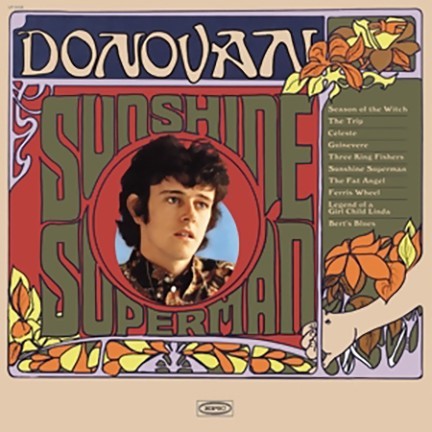
Sunshine Superman
Donovan’s Sunshine Superman was released in the United States on August 26, 1966. It was his third album and became one of the defining psychedelic records of the era.
Donovan was only 20 years old.
Jimmy Page, then working as a session musician, played guitar on several of the tracks. His playing on “Season of the Witch” and the title track helped give the album its eerie, psychedelic character.
The album became Donovan’s biggest American success. The “Sunshine Superman” single reached No. 1 on the Billboard Hot 100.
But Shawn Phillips’ role in the story went back even further.
Two young musicians in London
In the early 1960s, before either man was famous, Donovan and Shawn were roommates in a London flat.
They were two young musicians chasing the same dream.
Shawn told me they would sit around playing guitars into the early hours of the morning, sharing riffs and song ideas. Neither had a manager or a contract yet.
Phillips already had two folk albums on Columbia and was recording with Donovan. He also wrote “Little Tin Soldier,” which Donovan later recorded.
Through Donovan, Shawn met the Beatles and provided backing vocals for “Lovely Rita.” He was also among the early Western musicians experimenting with the sitar, an instrument he said he introduced to George Harrison before Harrison encountered Ravi Shankar.
Their London flat became a gathering place for musicians and future stars.
Bill Cosby stopped by.
Paul Simon would bring melodies he was working on, including what would become “Parsley, Sage, Rosemary and Thyme.”
Down the street at the Dick James music publishing office, another young musician was banging away at the piano, trying to get noticed.
His name was Elton John.
It was an extraordinary time to be living in London.
And Shawn and Donovan were right in the middle of it.
Back to the reunion
In late May 2011, Shawn and I arrived in London.
There was one small problem.
Shawn hadn’t played the sitar in 40 years.
He picked it up anyway.
Within minutes, he was remembering Donovan’s songs as if he had never put the instrument down.
At the Royal Albert Hall, we went through soundcheck.
Afterward, I wandered through the building, thinking about all the legendary concerts that had taken place there.
The place felt like I was walking inside a record jacket.
Then Jimmy Page appeared for his soundcheck.
I approached him and asked for a photograph.
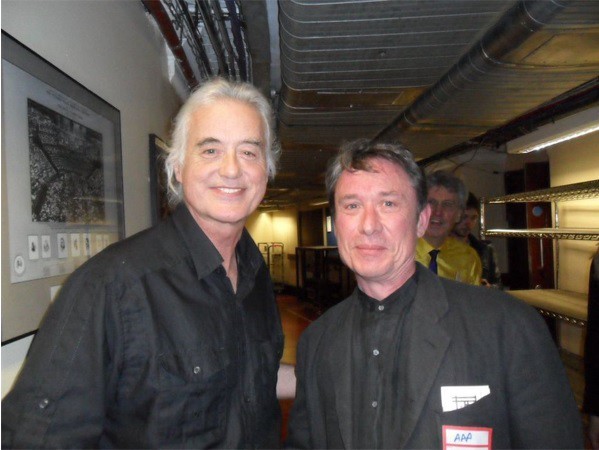
When I introduced myself as Shawn’s manager, Page jabbed me about it.
I took it as a sign that, like Donovan, he had no particular love for managers.
The night at Royal Albert Hall
The concert itself went down without a hitch.
The Royal Philharmonic Orchestra gave the evening a sense of occasion, and Shawn performed the sitar parts he had originally recorded four and a half decades earlier.
I thought Donovan was a little off his game that night.
The Royal Albert Hall was about 60 percent full—not quite enough people to make the economics of the show work.
But financially, that wasn’t really the point anymore.
Forty-five years had passed.
After the concert, we attended a press party.
Jimmy Page sat quietly at the bar with a glass of water. Before long, fans began gathering around him.
Donovan had a gypsy tent set up over a table. Inside, he sat like a crystal-ball reader, giving interviews to the press.
The next morning, Donovan had breakfast with us.
For the first time in decades, Donovan and Shawn sat together and talked.
There was no dramatic confrontation.
No grand speech.
They talked about Donovan’s children, his future projects, and his life in Ireland.
Then, after 45 years, they shook hands.
And hugged.
I had spent years managing Shawn through the complicated history between these two musicians. Watching that moment was deeply satisfying.
I hoped it wasn’t just the end of an old feud.
I hoped they might become friends again.
Maybe, just maybe, they might even write another hit together.
Forty-five years after two young musicians shared a London flat, the circle had finally closed.