People carried tents, backpacks, coolers, blankets, children, and pets. They pulled wagons and anything else that might be handy for camping—or creating a new civilization.
No one was selling tickets.
The entrance gates had been torn down.
It was a free-for-all.
Woodstock became an overnight experiment in communal living that had risen in organic chaos from the edges of a music stage. The great cosmic switch that controlled time was in the off position.
I slept the first night in a stranger’s car.
By the second day, there was no place to go to the bathroom.
Anyone with food gave it away.
Hundreds of thousands were too stoned to argue or complain. It was a human anthill filled with sweaty, naked, freaked-out, love-filled, groovy-vibe, dancing people—bored or wrecked, but always dancing.
The MASH tent was inundated with drug-related cases, women having babies, broken ankles, dehydration, and all the pandemonium associated with a disaster.
Helicopter crews tried to keep up with the supplies. It was up to each individual to share whatever they could for the survival of the tribe.
If it hadn’t been for the rain that washed away the stink and provided a little drinking water, the place would have been a full-fledged wipeout.
Some even welcomed the mud.
Large groups turned it into a playground, wore mud hats, and walked around nude like ancient tree worshippers.
I kept making my way through the sea of mud and people toward my ultimate destination—the stage.
Behind the stage, I saw a gypsy camp made from basically anything that could provide a makeshift tepee.
It was on that side of the camp chaos that I stumbled upon the Hog Farm Family and their leader—Wavy Gravy.
“Man, there’s always a little bit of heaven in a disaster area,” Wavy repeated in a hoarse voice.
Earlier, he had been shouting into the stage microphone that he and the other families had created enough free kitchens to feed 400,000 people for breakfast.
“So don’t worry.”
I liked Wavy in his funny, large hat and missing teeth. He had a lot of enthusiasm for what was happening. He didn’t have a negative atom in his body.
He believed that the world could be changed, and if you stood next to him, you believed it, too.
In the background was the constant roar and wildness of the music.
Depending on where you stood, the stage looked like a tiny pebble surrounded by a sea of ants. If you crawled in too close, you might be crushed by the crowd.
Day and night, the music seemingly played nonstop, like a soundtrack to the improvised nature of the setting.
The Merry Pranksters
Various groups had set up free kitchens and campfires.
At the Merry Pranksters’ campfire, I found Rocket’s Red Glare dancing by herself in a granny dress.
“Hello, Rocket’s Red Glare. How’s the party?” I asked.
She was blowing bubbles and sent about a dozen floating orbs toward my head as “Gr-o-o-o-o-o-vy” rolled off her tongue with a giggle.
Rocket’s Red Glare danced around me in a circle, humming and giggling while she blew bubbles at me.
I laughed along with her.
“Great bubbles, babe,” I teased, enjoying her show. “I can see you’re having fun.”
I danced a little jig with her while dodging and popping her bubbles.
“That’s my tepee over there,” she announced, pointing to a clump of trees. “Want to be my love beast?”
“Very tempting offer,” I chuckled, “but I found myself a place beneath the stage.”
“What do you think of the festival?” she asked.
“I think if I tried to describe it for the next 25 years, I wouldn’t do it justice,” I answered. “Too bad it has to end. Then again... could it really go on?”
“It’s a new dawn,” she said, glowing.
“Yes. It’s the dawn of something,” I nodded.
“You know where I live, little guitar man. See you later,” she sang to me as she and her bubbles danced away.
From the Merry Pranksters’ camp, I sat and watched the steady stream of music hipsters stopping by to show their support with an acoustic guitar.
I first saw the effervescent John Sebastian and a buddy who played a set of songs about his travels across America in an RV.
Later, to my surprise, the shaggy-bearded Jerry Garcia of the Grateful Dead and Marty Balin, founder and lead guitarist of Jefferson Airplane, appeared together. They did a short, blues-based jam.
The husky-voiced Melanie followed later and sang a few classic folk songs.
A stoned Tim Hardin plucked his way through a few songs before he dropped his guitar.
I was most intrigued by their fingerpicking style.
I wanted to learn how to do it.
Many of my favorite songs were fingerpicked. I just didn’t know how to do it, and it drove me crazy.
I approached one of the Hog Farm players and asked him how to do that trick with the right hand.
“How do you pick with the thumb, index, and ring finger, like I see everyone doing?” I asked Jack Flash.
“That is called Travis picking, or the claw,” he explained. “It was named after Merle Travis, thus the name.”
He reached for my guitar, and I reverently obliged.
“There are many variations of the technique,” he continued, slowly demonstrating the style on my guitar. “Keep practicing. You’ll get it eventually.”
“Thanks for the lesson, Jack,” I told him with enthusiasm and gratitude.
He handed my guitar back, and I handed him my cube of LSD.
I immediately spent the rest of the night memorizing the pattern.
Beneath the stage
I’d hung back long enough.
I was ready to make my big move.
It turned out it wasn’t difficult to slip past the overwhelmed backstage crew with my dream pass and walk across the wooden footbridge to build a fort beneath the stage.
As long as I sat quietly out of the way, no one cared that a mud-clad, 15-year-old was trying to build his vision of working in the music business.
In front of the stage, a sound-mixing console rose out of the mud.
To protect it from the rain, the equipment was covered by a makeshift tarp. Beneath the tarp, a person with thick sideburns and glasses, wearing an Australian-type Outback hat, was desperately trying to control the direction of the music.
I didn’t know it at the time, but I was looking into my future.
The man at the controls was the South African music promoter I’d be working with 25 years later to celebrate Nelson Mandela.
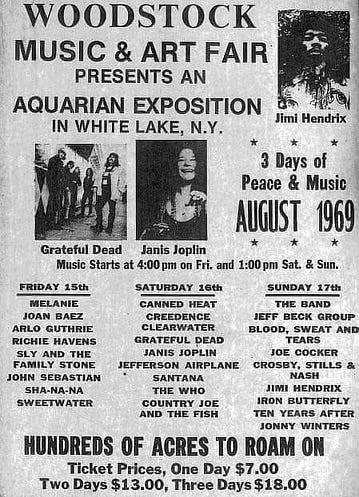
Before my wide eyes, one legend after another performed: Pete Townshend, Joan Baez, Hendrix, Carlos Santana, and even Arlo Guthrie.
Most were complaining about their start times, conditions, rain, monitor levels, money, hassles, and drugs.
I didn’t care.
All I cared about was the guitars.
With each artist came a rack of the most amazing electric and acoustic guitars I had ever seen.
I recognized the standard Fender and Gibson guitars, but the rock gods had custom-built instruments—exotic, handmade gems with pearl inlays, unique pickups, and golden tuning keys.
I sat there mesmerized, watching them tune and warm up.
Townshend gave his cherry-red Gibson SG a few windmills, while Arlo Guthrie carefully picked, listening for any anomalies in his fretboard.
If one guitar wasn’t perfect, a private guitar tech would appear with another.
I studied the musicians’ faces carefully before they went on before 400,000 people.
I noted whether they were calm or nervous, anxious or jumpy—or whether they seemed cool, had dry mouths, were stoned, or were straight.
There I sat in rapt observation, completely engulfed in a moment of sweet surrender, floating in my boat of bliss, awaiting with bated breath the chance to meet Jimi Hendrix.
Jimi Hendrix
Hendrix was scheduled to appear at midnight on the closing night but insisted on being the last to play.
Then, because of the many delays, he finally hit the stage at 8 a.m. the next morning.
After staying awake all night, I finally saw him enter the area in his red headband and white, buckskin-fringed shirt.
His famous white Fender Stratocaster hung over his shoulder.
Some of the crew believed that he was a god who talked through a guitar.
From my vantage point at the security fence, I could see Hendrix close up, towering above the crowd, glowing in stardust.
I had seen Hendrix a total of three times.
The most recent was two months earlier at the tear-gassed Denver Pop Festival.
But the show that day featured a new lineup of players. The band was introduced as Gypsy Sun & Rainbows.
I was unaware that I had seen the original Hendrix Experience group for the last time. I overheard that the show that day was the debut of Hendrix’s new band.
That new information added another layer of excitement for my hungry ears.
Hendrix was the most mystical of all the performers.
He wasn’t just a musician—he was a shaman who brought his visions to the tribe through his lightning rod.
When he stepped out there and plugged in, the air was pushed back three feet by the sheer thunder that emanated from his six-foot-high wall of amplifiers, like cosmic bookends to the 1960s.
Hendrix had sacrificed his guitar to usher in a new consciousness through fire at the Monterey Pop Festival.
Now, at Woodstock, he was closing the cultural journey of the 1960s with his brilliance, turning his guitar into a wizard’s wand.
He called his guitar a kinky machine that kissed the skies—and that was not an exaggeration.
The molded piece of white-painted wood and wire screamed as a seasoned mother would during labor, giving birth to the most amazing melodies I’d ever experienced, one after another.
Rockets exploded in multiple reds, whites, and blues as Hendrix’s supersonic interpretation of Francis Scott Key’s “Star-Spangled Banner” came over the sound system, blasting us all into the outer space of the underground.
The surreal interpretation of America’s national anthem caused me to reflect on my brother’s struggle to stay out of the Vietnam War.
My brother loved the guitar as much as I did, and I wished he was there to see Hendrix with me.
I was too young to be drafted, but when I looked around me, most guys would be—or were—facing a hitch into hell.
As Country Joe McDonald sang in his “I-Feel-Like-I’m-Fixin’-to-Die Rag,” if my brother’s tour had been switched to Nam, he might be coming home in a box.
For the next two hours, I stared dumbfounded at what I had never heard a guitar do.
The guitar played me, cut me to the core with precision—to the innermost reaches of my emotional hideouts—enraptured within his hypnotical rhythms.
I found myself floating somewhere beyond the innermost reaches of my emotional hideouts during this Hendrix Experience, on this third stone from the sun, where he invited us all to board his ship—and so I did, at the right of the helm, mind you—just underneath the stage.
My body shook to the sometimes distorted, over-the-top, innovative tunes of brilliance.
My world was definitely rocked.
And I was forever changed.
“Thanks, Jimi.”
The moment was chiseled upon my skull.
I would pick up a guitar, and nothing was the same.
Leaving Woodstock
Woodstock had shown me more than any other event of the time the possibilities of bringing people together through music.
Yes, Hunter Thompson called it “perhaps... the most overrated cultural event of the 20th Century,” but Woodstock sure did become one of the most memorable, groundbreaking moments in musical history ever recorded.
And yes again, those of us who attended participated in growing the grassroots of an epic moment in musical history, within a magical medley of music and mud, at the first-ever Woodstock celebration.
Three days later, the abandoned fields of Max Yasgur’s farm lay buried beneath mountains of empty wine bottles, clothes, and abandoned relics of modern civilization.
The “ECO” movement was a couple of years off.
One cultural experiment had risen and crashed.
I looked at my ruined Woodstock poster for the last time and pondered what would become of the Aquarians.
The light they carried.
What would become of such power?
The awareness?
Did it change anything?
Rocket’s Red Glare, where is your teepee?
I made my way back to the interstate and let out the wild thumb.
Thumb against the blade of a pocketknife.
Thumb as shiny fingernail of reflected camel eye.
Thumb as a safety-pin-sized, out-of-tune fiddle, plucking a cricket’s song.
Fifty years later, on the anniversary of Woodstock, I posted an “I was there” photograph on Facebook with an arrow pointing into a mosh pit of festival-goers.
I was surprised that, to this day, the event remained tattooed on the mainstream consciousness of pop history.
When I tell people, “I was there,” the remark usually invites a wide smile or a nod of the head in amazement.
“Really?”
Sort of like the same level as saying I climbed Mount Everest in a bathing suit.
I was now “one of them.”
The idea of raising social awareness and creating interpersonal harmony through music stuck with me and became a lifelong ambition.
I sure am glad I went.